September 13, 2026
Signing a consent form on a tablet — is it valid in Denmark?
Denmark applies the EU's electronic signature rules directly, with its own supplementary act and its own supervisory body. Here is what that means for a form signed on a tablet.
A studio owner who has only ever worked with paper often assumes a signature typed or drawn on a screen must be some kind of legal shortcut — valid in spirit, shaky in fact. In Denmark that assumption does not hold up, and the reason is that the rules governing electronic signatures are not a national improvisation. They come from an EU regulation that applies in Denmark exactly as it applies everywhere else in the Union.
The eIDAS Regulation applies directly — no translation needed
Denmark is a member state of the EU, so Regulation (EU) No 910/2014 — the eIDAS Regulation, governing electronic identification and trust services — applies directly, with the force of law, without needing to be copied into a separate Danish statute. What Denmark did add is a supplementary act to fill in the parts the Regulation leaves to national governments: administration, penalties and the designation of a supervisory body. That act is the Lov om supplerende bestemmelser til forordning om elektronisk identifikation og tillidstjenester til brug for elektroniske transaktioner på det indre marked (LOV nr. 617 of 8 June 2016). It places supervision of trust service providers with the Danish Agency for Digitalisation's eIDAS Supervisory Body (Digitaliseringsstyrelsens eIDAS Tilsynsorgan) — a different body from the Datatilsynet, and worth not confusing with it: one supervises trust services, the other supervises data protection.
The rule that actually matters for a consent form
Article 25(1) of the eIDAS Regulation states the core principle: an electronic signature shall not be denied legal effect and admissibility as evidence in legal proceedings solely on the grounds that it is in an electronic form or that it does not meet the requirements for qualified electronic signatures. That single sentence is doing most of the work here. A studio does not need to reach for the highest tier of electronic signature to have something that counts — it needs to be able to show what was signed, by whom, and that the document has not changed since.
The Regulation sets out three tiers: a simple electronic signature (data in electronic form, attached to or logically associated with other data, used by the signatory to sign), an advanced electronic signature (uniquely linked to the signatory, capable of identifying them, created using data the signatory can use under their sole control, and linked to the signed data so that any later change is detectable), and a qualified electronic signature — an advanced signature created by a qualified device and backed by a qualified certificate. Only the qualified tier carries the automatic legal equivalence to a handwritten signature that Article 25(2) grants; the other two are still valid, but their weight as evidence depends on what was actually recorded.
Why a flat image of a signature is the weak version
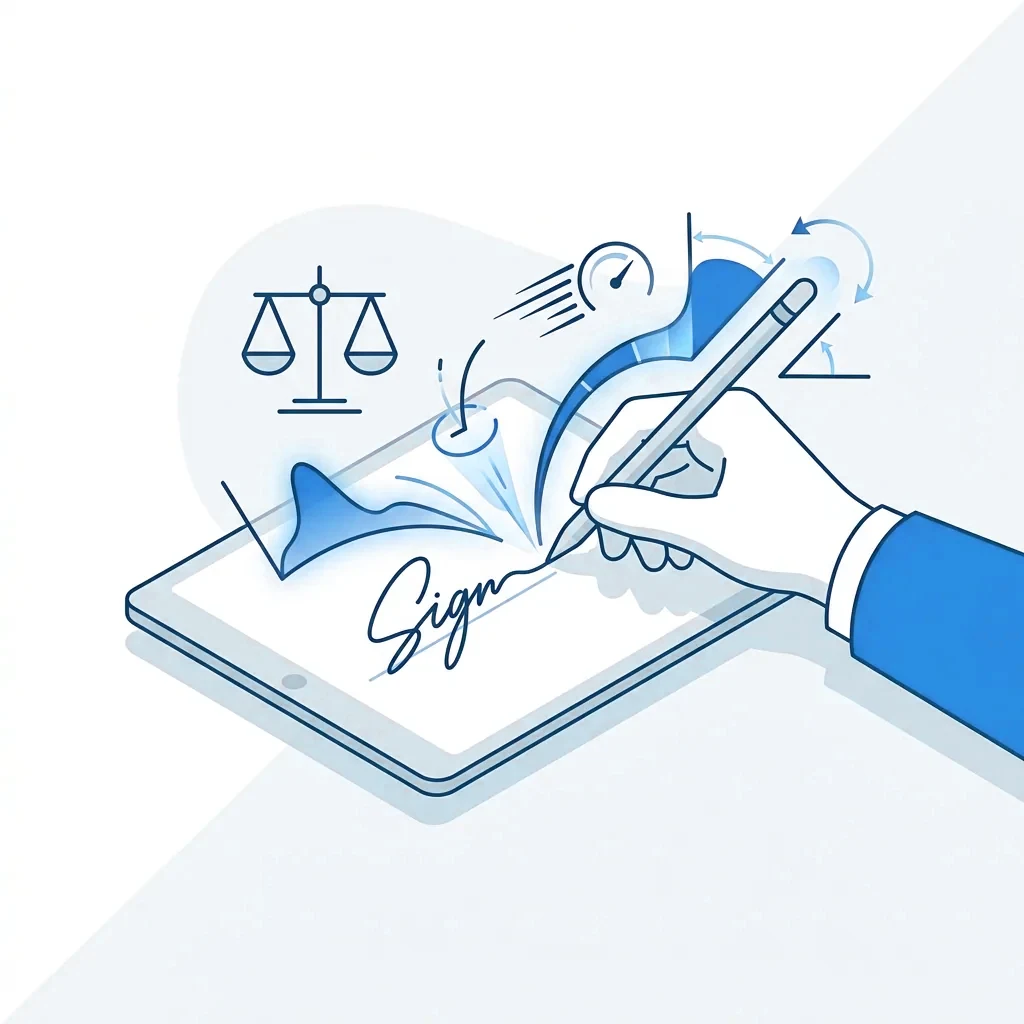
A signature saved only as a picture — a static image dragged onto a PDF — sits at the simple tier at best, and it is the least useful kind in a dispute, because it can be copied onto a different document with nobody able to tell the difference by looking at it. What separates a genuinely useful electronic signature from a picture of one is whether the system captured the biometrics of the act of signing itself: the path of the stroke over time, the pressure, the speed, the rhythm. Those characteristics are specific to the person who produced them and hard to reproduce, which is exactly what makes them worth comparing if a client later disputes having signed at all.
Integrity: proving the document did not change afterwards
A signature answers "who signed." It does not, on its own, answer "has this document been altered since." That second question needs its own evidence — typically a cryptographic hash taken at the moment of signing, so that any later change to even a single character produces a different hash and is immediately detectable. Without that, a signed PDF carries the same evidentiary weight as a photocopy: worth exactly as much as the other side is willing to concede.
When to reach for a qualified signature instead
For a treatment consent form — tattoo, piercing, aesthetic, dental — Danish law does not prescribe a specific statutory form for the signature, so there is no requirement to use a qualified electronic signature under eIDAS. An electronic signature with the biometrics of the signing captured and the document's integrity protected by a hash is a stronger position than paper, which carries no timestamp and can go missing in a drawer. Which tier of the Regulation it reaches depends on the specific solution — and in a dispute it is the evidential weight that counts, not the label. Qualified signatures earn their overhead where a specific Danish or EU rule demands a handwritten-equivalent form — certain notarial acts, some company filings — categories a consent-to-treatment form does not fall into.
Three questions worth asking your software supplier
Does it record the biometrics of the signing, or only a flat image? Is the document's integrity protected by a hash and a timestamp, and can both be verified independently? And can the signed record actually be exported and handed to someone — a client, an insurer, a court — rather than living only inside the supplier's own interface? A signature you cannot get out of the system is not evidence; it is a claim that evidence once existed.
This article is for information only and is not legal advice.
Protect your business today
Try Aprovo free for 30 days and leave the paperwork behind.
Start your free trial