15.06.2026
Signing on a tablet — does it actually hold up
There is a persistent belief that a finger-drawn signature means nothing in court. It is wrong — but not baseless, and the reason matters.
Signing on a tablet — does it actually hold up
"That would never stand up in court" is the most common thing said about signing on a tablet. It is wrong, but it is not baseless: everything depends on what the system actually records.
What UK law says about electronic signatures
The Electronic Communications Act 2000 provides for the admissibility of electronic signatures in legal proceedings. The UK eIDAS Regulation — the retained version of the EU regulation — sets out the same three tiers: simple, advanced and qualified.
The principle that matters is that an electronic signature cannot be denied legal effect or admissibility solely because it is electronic. In 2019 the Law Commission confirmed the position for England and Wales: an electronic signature is capable of satisfying a statutory signature requirement, provided the signatory intended to authenticate the document.
So a court will not throw it out on sight. It will weigh how reliable it is — and that is where the real difference lies.
Why the picture of a signature is the weak version
A consent to a treatment does not need to be in any prescribed form. You do not need a qualified signature. What you need is evidence that a specific person read specific wording and accepted it.
A wet signature on paper is that evidence, because a handwriting expert can examine it. A signature saved as a flat image is not, because it can be copied and pasted under any document.
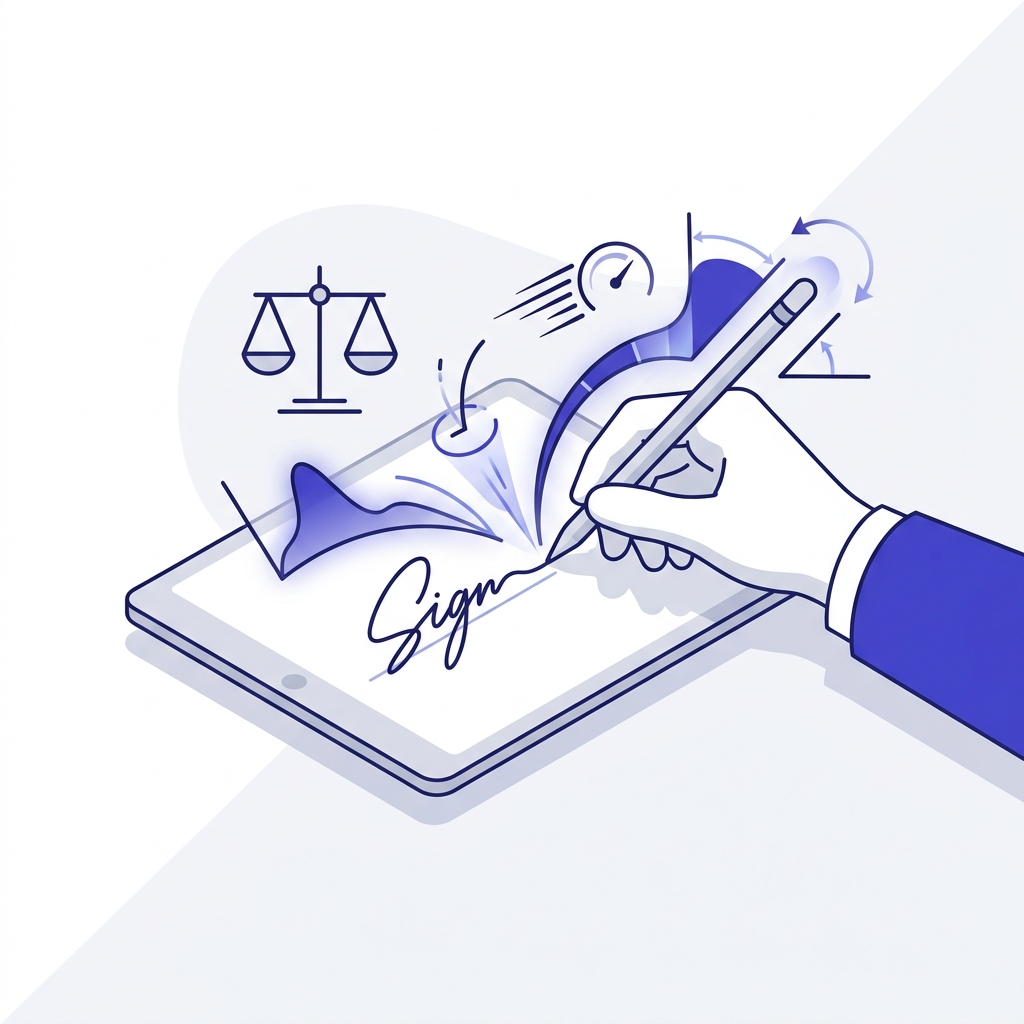
The difference is whether the system captured the biometrics of the act of signing: the path of the stroke over time, pressure, speed, rhythm. Those are difficult to forge and let an expert compare them the same way they would compare ink on paper.
Integrity is the other half
The signature alone is not enough. You also have to show that the document has not changed since it was signed.
A cryptographic hash taken at the moment of signing does that: change one character and the hash is completely different, so any tampering shows up in a comparison. Without it, a signed PDF is worth what a photocopy is worth.
Three questions for your supplier
Do you record the biometrics of the signing, or only an image? If only an image, you have a scan, not a signature.
Is document integrity protected? There should be a hash, a timestamp, and a way to verify both.
Can it be exported? Evidence you cannot get out of the system and put in front of someone is not evidence.
The practical conclusion
For consent forms in a tattoo studio, a beauty salon or a dental practice, an advanced electronic signature with captured biometrics and a document hash is sufficient — and stronger than paper, because paper fades, goes missing and carries no timestamp.
Qualified signatures belong where a statute demands a specific form. Consent to a treatment is not one of those cases.
This article is for information only and is not legal advice.
Protect your business today
Try Aprovo free for 30 days and leave the paperwork behind.
Start your free trial