September 13, 2026
Signing a consent form on a tablet in Sweden — what the law actually asks for
Sweden is a country that trusts electronic identity more than most, through BankID. That makes it easy to assume a consent form needs the same level of signature. It does not.
In a country where BankID is how people log into their bank, sign tax returns and pick up parcels, it is tempting to assume every electronic signature needs to reach that bar. A client consent form does not — and knowing exactly why saves a studio from either under- or over-building its process.
eIDAS applies directly, the same as in the rest of the EU
Sweden is an EU member state, so Regulation (EU) No 910/2014 (eIDAS) applies directly, without needing to be copied into Swedish law first. Sweden's own supplementary act, Lag (2016:561) med kompletterande bestämmelser till EU:s förordning om elektronisk identifiering, fills in the pieces the regulation leaves to member states: supervision, appeals and fees for trust service providers operating in Sweden. It does not create a separate signature regime — it plugs Swedish administration into the EU one.
eIDAS sets out the same three tiers everywhere it applies: simple, advanced and qualified electronic signatures. Article 25(1) states the principle that carries the whole framework: an electronic signature shall not be denied legal effect and admissibility as evidence in legal proceedings solely on the grounds that it is in an electronic form or does not meet the requirements for a qualified electronic signature. A signature is not thrown out for being electronic — it is weighed on how reliable it actually is.
Who supervises trust services in Sweden
The supervisory authority for trust services under eIDAS in Sweden is the Post- och telestyrelsen (PTS). PTS approves qualified trust service providers, receives the security-incident reports providers must file under Article 19 of the regulation, and is the body a provider or a complaint would ultimately reach. BankID itself operates as a trust service within this same supervised landscape — which is part of why Swedish clients are unusually comfortable with electronic identity in the first place.
Why a client consent form does not need BankID-level signing
A consent to a tattoo, piercing or beauty treatment has no statutory form requirement — nothing in Swedish law demands a qualified electronic signature, still less a BankID-level identification, for it to be valid. What it needs is evidence that a specific person read specific wording and agreed to it. That is a simple electronic signature under eIDAS, and Article 25(1) is exactly what protects it from being dismissed for that reason alone.
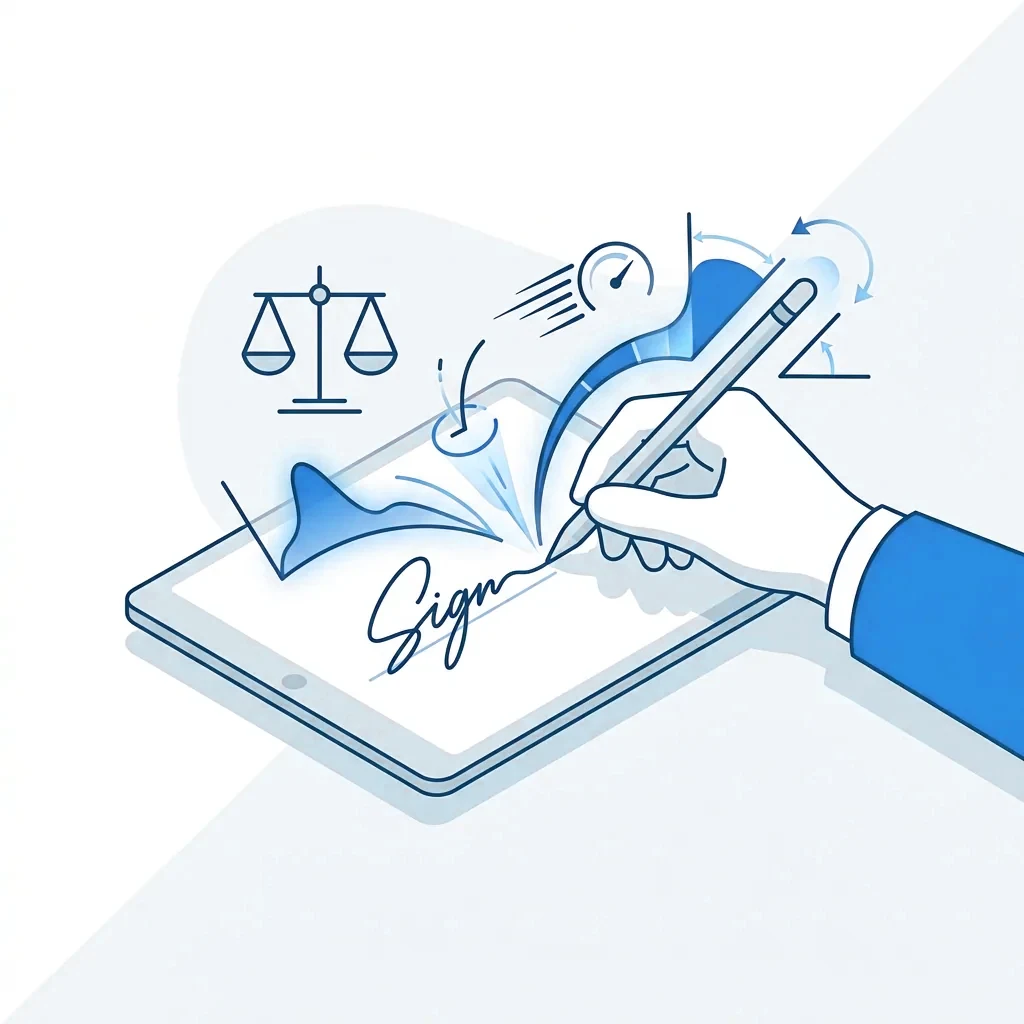
The distinction that actually matters is not simple-versus-BankID, it is image versus captured signature. A signature saved as a flat picture can be copied onto any document. A signature captured with its biometrics of the act of signing — the path of the stroke over time, its speed, pressure and rhythm — is something a comparison can be made against, the way an expert would compare ink strokes on paper. A tablet that records only an image has produced a picture, not a signature.
Integrity is the other half of the answer
Capturing the signature well is only half the evidence. The other half is proving the document itself has not changed since it was signed — normally done with a cryptographic hash taken at the moment of signing, so that altering even one character afterward produces a completely different hash and exposes the change. A signed document without that check is worth what an unverified photocopy is worth: exactly as much as the other side is willing to concede.
Three questions worth asking a supplier
Does it record the biometrics of the signing, or only save an image? An image is a scan of a signature, not a signature.
Is the document's integrity protected after signing? There should be a hash and a timestamp, and a way to verify both later.
Can the record be exported? Evidence that cannot be pulled out of the system and shown to someone — a client, an authority, a court — is not evidence yet, whatever it says on screen.
The practical conclusion
For a treatment consent form in a Swedish studio, an electronic signature with captured biometrics and a document hash meets what the law actually asks for — and holds up better than paper, which carries no timestamp and can go missing. Qualified signatures and BankID-level identification belong to a different category of problem: proving who exactly someone is to a very high bar, such as for a legal contract or a bank transaction. A client agreeing to a tattoo is a different question, and Swedish law does not ask it to be answered the same way.
This article is for information only and is not legal advice.
Protect your business today
Try Aprovo free for 30 days and leave the paperwork behind.
Start your free trial