September 13, 2026
Does a tablet signature hold up in Norway? Outside the EU, inside the same rulebook
Norway isn't an EU member, but it runs the same electronic signature standard as the rest of the market — adopted through the EEA, the same route GDPR took.
A studio owner in Oslo could reasonably wonder whether "signed on a tablet" means something different in Norway than it does in an EU country. It doesn't — and the reason is the same mechanism that already governs how GDPR reaches Norway: the EEA, not the EU.
How the EU signature standard became Norwegian law
Norway adopted the EU's electronic identification and trust services framework — Regulation (EU) No 910/2014, commonly known as eIDAS — through lov om elektroniske tillitstjenester (LOV-2018-06-15-44), the Act on Electronic Trust Services, passed 15 June 2018. Section 1 of the Act provides that the eIDAS Regulation applies as Norwegian law, with the adaptations that follow from Annex XI of the EEA Agreement and Protocol 1 to that agreement. Two supporting regulations fill in technical detail: forskrift om tillitstjenester for elektroniske transaksjoner (FOR-2019-11-21-1577) and the self-declaration regulation for electronic identification schemes, selvdeklarasjonsforskriften (FOR-2019-11-21-1578).
The pattern will look familiar if you've already read how GDPR reached Norway: not EU membership, but an EEA Joint Committee decision incorporating the EU text, followed by a domestic implementing act. Electronic signatures took the identical route. A Norwegian studio operates under the same three-tier signature framework — simple, advanced and qualified — as a studio anywhere else the Regulation applies directly.
The tier that matters for a consent form
eIDAS does not require a specific signature tier for most private transactions, including a client's consent to a tattoo, piercing or aesthetic treatment. Norwegian law does not impose a qualified-signature requirement here either — there's no statute making a wet signature or a qualified electronic signature a precondition for a valid treatment consent. What the framework does guarantee, carried into Norwegian law through the same 2018 Act, is that an electronic signature cannot be denied legal effect or admissibility solely because it is in electronic form.
That guarantee sets a floor, not a target. A court or a supervisory body won't dismiss a tablet signature on sight — but it will still weigh how reliable that particular signature actually is, and that's a question of what the system captured, not which country the studio operates in.
Why a static image of a signature is the weak version
A consent form doesn't need a prescribed form or a qualified signature. What it needs is evidence that a specific, identifiable person read specific wording and agreed to it. A signature drawn once and saved as a flat image can be lifted and pasted under a different document with no trace of that happening — it proves very little on its own.
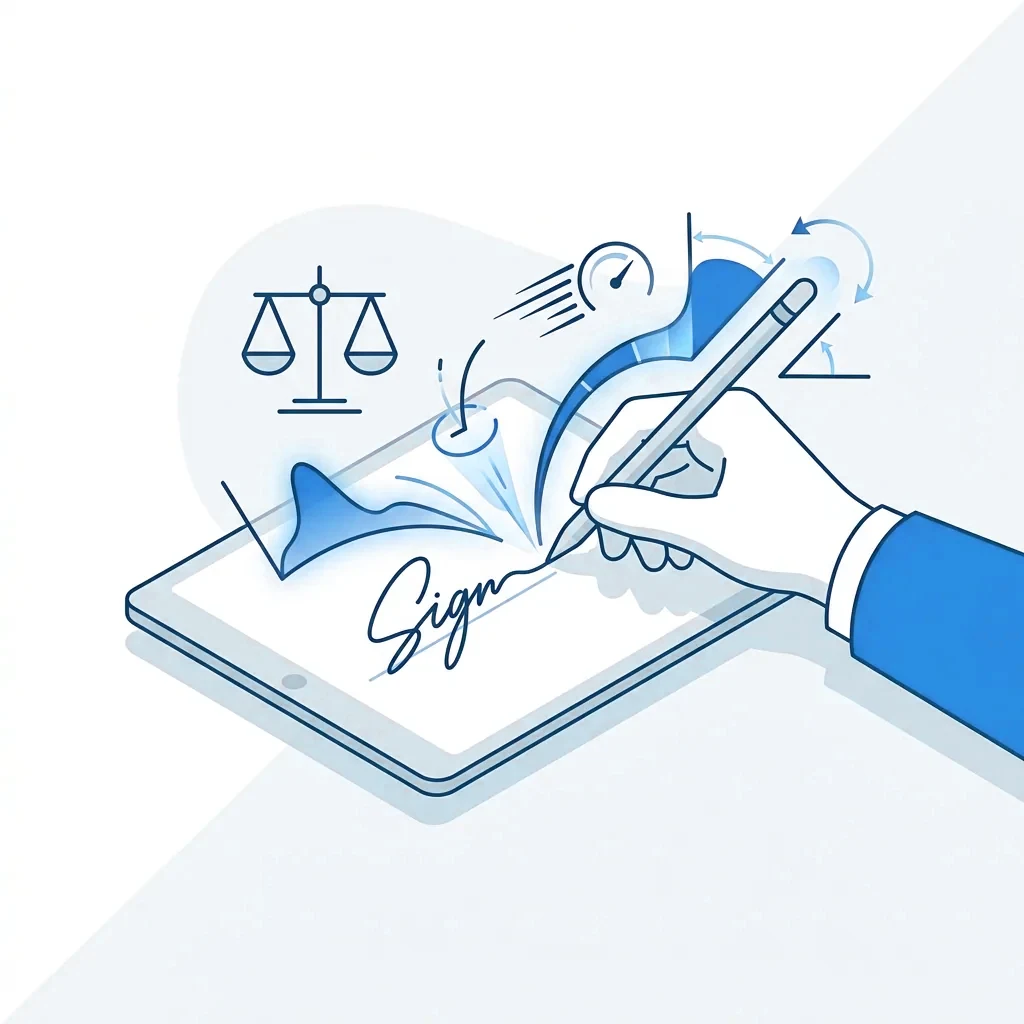
What makes an electronic signature comparable to a handwritten one on paper is capturing the biometrics of the act of signing itself: the path the stylus or finger traced, pressure, speed, rhythm over time. Those characteristics are difficult to forge and can be examined the same way a handwriting expert would examine ink strokes on paper.
Integrity is the other half of the answer
A well-captured signature only proves that someone signed something. It says nothing about whether the document you're holding today is the one they actually signed. That's a second, separate property: proof that the content has not changed since the moment of signing.
A cryptographic hash generated at the moment of signing supplies that proof — alter a single character afterward and the hash no longer matches, so any tampering becomes detectable on comparison. Without it, a signed PDF carries the same evidentiary weight as a photocopy: worth exactly what the other side is willing to concede.
Three questions worth asking any supplier operating in Norway
Does the system record the biometrics of the signing itself, or only a picture of the result? A picture is a scan, not a signature capable of being examined.
Is the document's integrity protected with a hash and a timestamp, and can both be independently verified? Without this, the strongest signature in the world is attached to a document nobody can prove hasn't been edited since.
Can the evidence be exported and shown to someone outside the system? Evidence trapped where nobody but the software vendor can retrieve it does not function as evidence when a client disputes what they agreed to.
The practical conclusion for Norwegian studios
For consent forms in a tattoo studio, a beauty salon or a dental practice operating in Norway, an advanced electronic signature — one that captures the biometrics of signing and produces a document hash — meets and exceeds what paper offers, under a legal framework Norway applies in full even without EU membership. Qualified signatures remain reserved for the narrower set of cases where a specific statute demands that particular form; a treatment consent has not been one of them under the research behind this article, and nothing found in the Norwegian implementation of eIDAS changes that assessment.
This article is for information only and is not legal advice.
Protect your business today
Try Aprovo free for 30 days and leave the paperwork behind.
Start your free trial