November 15, 2026
Written aftercare in Sweden — what the National Board of Health and Welfare recommends, and why the signature matters
Since 1 February 2026, Swedish general advice recommends written information after the procedure on aftercare, looking after the area and whom to contact. For laser and IPL, the radiation authority adds its own requirement to inform the client about aftercare.
A tattoo takes an hour; healing takes weeks, and it happens at the client's home. When something goes wrong, the dispute is rarely about the needle. It is about what the client did afterwards, and whether anyone told them not to.
What the rules say
The National Board of Health and Welfare's general advice HSLF-FS 2025:62, in force since 1 February 2026, recommends risk information before the procedure and written information afterwards covering three things:
- the specific aftercare needed;
- how to look after the treated area;
- whom to contact if complications arise.
The advice is not a binding regulation, but it is what municipal inspectors work from when they assess whether a business meets the Environmental Code. For laser and IPL, the Swedish Radiation Safety Authority's rules also require that the client is informed about aftercare.
Why the signature matters
Swedish tort law is cautious about blaming the client: for personal injury, chapter 6, section 1 of the Tort Liability Act (1972:207) only reduces compensation if the injured person contributed intentionally or through gross negligence. That is exactly why evidence weighs so much. A studio that can show the client got written advice — and still went swimming the next day — is in a different position from one where nobody can say what was said at the counter.
What the instructions should contain
- The first hours: when to remove the dressing or film, how and with what to wash.
- The following days and weeks: what to apply, how often, what not to touch.
- What to avoid and for how long: sun and sunbeds, swimming and saunas, scratching and picking — in days or weeks, not "for a while".
- Signs that are not normal: spreading swelling, fever, pus, an unpleasant smell — and what to do.
- Who to contact: the studio, and when to go straight to healthcare.
- Proof of receipt: the client's signature and a copy to take home.
For laser, add sun protection between sessions; for piercing, the healing time for that site and jewellery. What the consent form must contain is in our article on tattoo age and consent in Sweden. Health data is special category data under Article 9 GDPR, supervised by IMY.
How Aprovo handles it
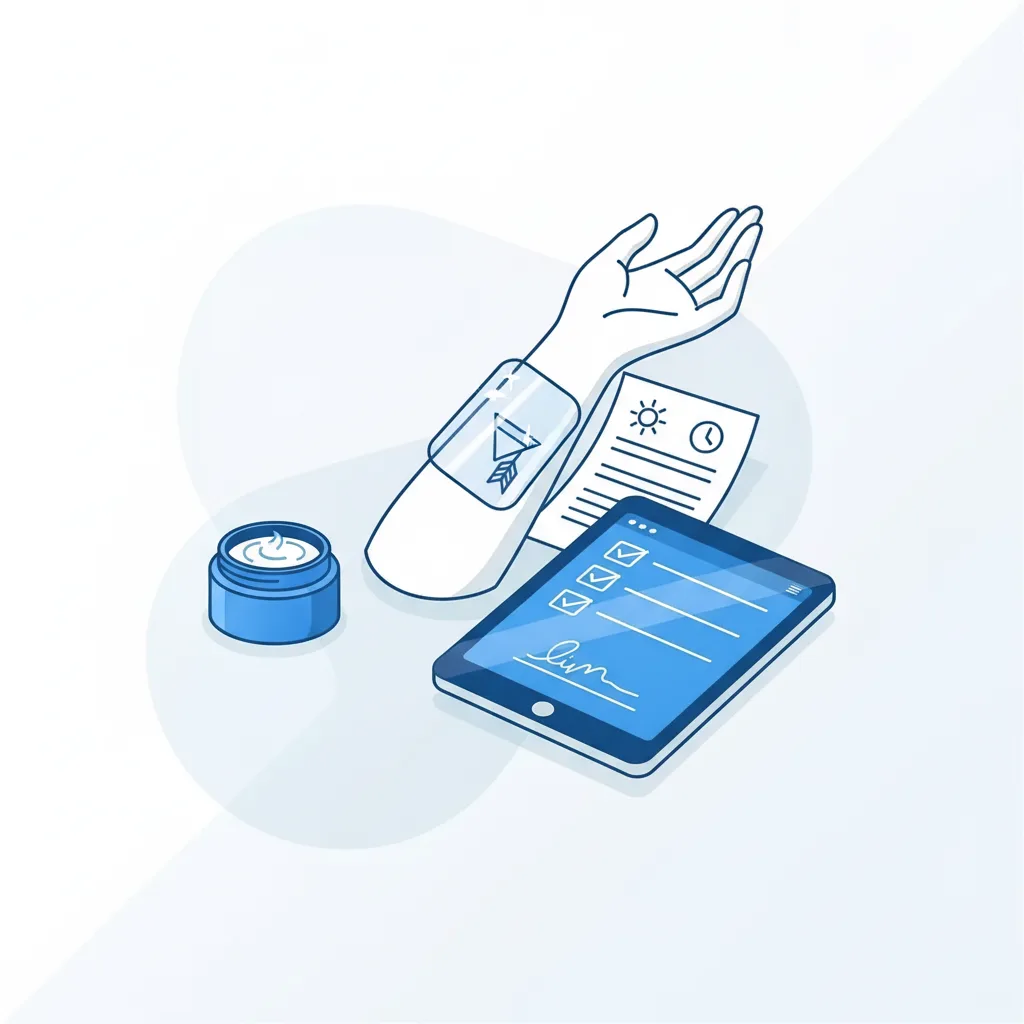
Each industry set — tattoo, piercing, laser, dental — has its own aftercare document, which the client reads on the tablet and acknowledges with a signature. It goes into the same PDF as the consent, and the studio can email the client a copy with one button.
In short
Written aftercare covering the three points in HSLF-FS 2025:62, and for laser the radiation authority's information requirement. The signed copy is the proof the client received it.
This article is for information only and is not legal advice.
Protect your business today
Try Aprovo free for 30 days and leave the paperwork behind.
Start your free trial